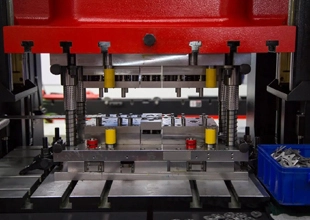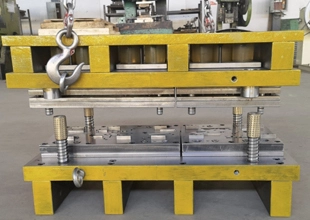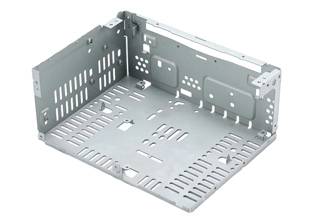
According to the nature of the compound process, it can be divided into:
Punching compound mold: such as material cutting composite mold.
Forming compound molds: such as composite extrusion molds.
Compound die for blanking and forming: such as a composite die for material cutting and deep drawing.
According to its structural form, it can be divided into:
Sequential compound mold: a compound stamping die with a concave mold device in the lower mold.
Inverted compound mold: a compound stamping die with a concave mold device in the upper mold.
Comparison of Compound Stamping Die Structures:
Inverted composite mold | sequential composite mold | |
Leakage | From the leakage hole of the lower mold | Return to the mold working surface |
Output | From the upper mold | From the bottom mold |
Operation | Safe and convenient | Poor operation |
Workpiece | Poor flatness | Good flatness |
Stress | Poor stress and poor strength | Good stress |
Wear | Relatively small | Relatively large |
Working face | Easy to clean | Difficult to clean |
Through the above comparison, it can be seen that their applicable range is:
1. Inverted composite molds are suitable for punching parts with low requirements for flatness and sufficient strength of convex and concave molds;
2. The sequential composite compound and progressive dies is suitable for punching thin materials or composite dies with high requirements for flatness, insufficient strength of convex and concave dies, or without punching waste.

 English
 日本語
日本語 Deutsch
 Español
 français
 italiano
 Polska
 العربية
 čeština
 Svenska
 Nederland