As industries such as automotive, electronics, medical equipment, aerospace, and industrial automation continue to demand smaller, lighter, and more accurate metal components, manufacturers are facing increasingly strict requirements for production consistency and dimensional control. Traditional stamping methods may struggle to achieve the combination of efficiency, precision, and complexity required by today’s advanced applications.
Compound die stamping has become an important manufacturing solution for producing precision metal parts by completing multiple cutting and forming operations within a single press stroke. This integrated approach helps reduce process complexity, improve production efficiency, and maintain consistent part quality for components with demanding specifications.
For manufacturers evaluating precision metal forming solutions, understanding how compound die stamping works, how it compares with other stamping methods, and what factors influence its performance is essential for selecting the right production strategy. YX Technology applies advanced stamping expertise and engineering capabilities to support high-precision metal component manufacturing across different industries.
The development of modern products has significantly increased the demand for precision metal components. Electronic devices require smaller conductive parts, automotive systems rely on highly accurate structural components, and medical equipment requires stable dimensions to ensure reliable performance. These applications often involve tight tolerances, complex geometries, and high-volume production requirements.
Manufacturers are no longer focused only on producing large quantities of parts. They must also achieve repeatable accuracy, minimize material waste, and maintain stable production quality throughout long manufacturing cycles. This shift has increased interest in advanced stamping technologies such as compound die stamping.
Unlike conventional stamping processes that may require multiple production stages, compound die stamping combines several operations, such as punching and blanking, into one manufacturing step. This reduces the need for additional handling between processes and helps improve overall dimensional consistency.
Another important factor is the growing need for cost-effective precision manufacturing. By reducing secondary operations and improving production efficiency, compound die stamping allows manufacturers to balance quality requirements with practical production goals.
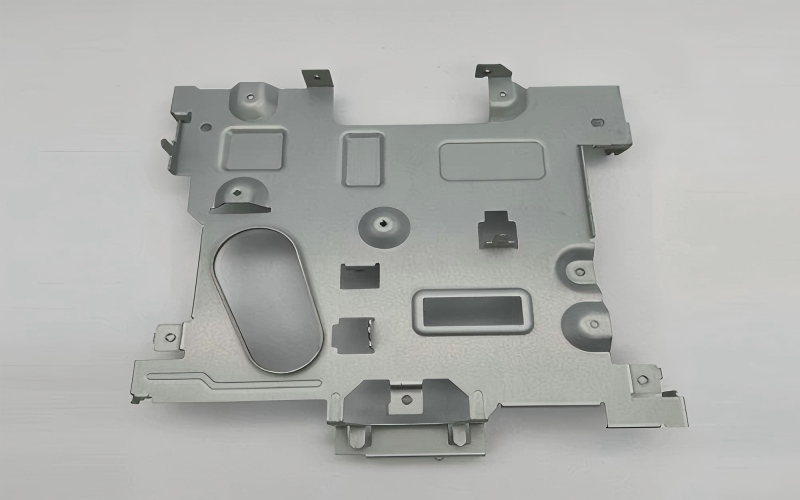
The key advantage of compound die stamping is its ability to perform multiple operations simultaneously during a single press stroke. A compound die typically contains multiple cutting elements arranged in one die structure, allowing the material to be processed through several actions at the same time.
For example, a single stroke may complete both internal hole punching and external profile cutting. Instead of transferring the part between different machines or dies, the complete component can be produced in one integrated operation. This approach improves production efficiency while reducing the risk of errors caused by repeated positioning.
When comparing compound die and progressive die technologies, the main difference lies in their operating principles. A compound die completes multiple operations at one station during a single stroke, while a progressive die performs different operations at multiple stations as the material moves through the die.
| Comparison Factor | Compound Die Stamping | Progressive Die Stamping |
|---|---|---|
| Manufacturing Method | Multiple operations completed at one station in one press stroke | Multiple operations completed across different stations in sequence |
| Part Accuracy | High dimensional consistency due to single-stage processing | High efficiency but accuracy depends on material movement and station alignment |
| Production Speed | Suitable for precision components with moderate to high volumes | Highly suitable for very high-volume continuous production |
| Component Complexity | Ideal for parts requiring simultaneous cutting operations | Better for components requiring multiple progressive forming steps |
| Tool Structure | More compact die structure with precise alignment requirements | Longer die structure with multiple processing stations |
The selection between compound die and progressive die depends on factors such as component design, production volume, material characteristics, and required tolerances. For precision flat components with multiple cutting requirements, compound die stamping often provides significant advantages.
Dimensional accuracy is one of the most important performance indicators in precision stamping. The quality of a stamped component depends not only on the stamping machine but also on die design, material control, process stability, and maintenance practices.
Advanced compound die design focuses on optimizing clearance, alignment, cutting force distribution, and structural strength. Proper die clearance helps reduce burr formation and improves edge quality, while precise alignment ensures that different operations are completed accurately within the same stroke.
Modern manufacturing also relies on strict process monitoring. Parameters such as press force, material feeding accuracy, and tool wear conditions must be controlled to maintain consistent output. Small variations in these factors can influence final component dimensions, especially in high-precision applications.
YX Technology integrates engineering evaluation, precision tooling knowledge, and manufacturing control processes to support reliable stamping production. Companies seeking detailed information about available precision manufacturing capabilities can explore YX Technology’s precision metal manufacturing services, which cover different requirements from tooling development to production support.
The material selected for stamping has a direct impact on production stability, tool lifespan, and final component performance. Different metals have different levels of hardness, ductility, springback behavior, and wear resistance, which influence how they respond during stamping.
Common materials used in compound die stamping include stainless steel, carbon steel, copper alloys, aluminum alloys, and other engineering metals. Stainless steel is often selected for corrosion resistance and mechanical strength, while copper alloys are widely used when electrical conductivity is important.
Material thickness is another important consideration. Thin materials require highly accurate die clearance and feeding control, while thicker materials may require stronger tooling structures and higher press capacity. Selecting the appropriate material grade helps achieve better stamping performance and reduce production issues.
In addition, surface treatment and material consistency can influence tool wear and component quality. High-quality raw materials with stable mechanical properties contribute to more predictable stamping results.
Although stamping technology continues to evolve, compound die stamping remains widely used because it provides a strong balance between precision, efficiency, and production reliability. It is particularly suitable for components where dimensional accuracy and consistent geometry are critical.
Applications include electronic terminals, connector components, precision brackets, automotive parts, hardware components, and industrial assemblies. These parts often require stable dimensions because even small variations can affect assembly performance or product reliability.
The relationship between compound die and progressive die selection is also important when designing a manufacturing strategy. Progressive dies may offer advantages for extremely high-speed production with complex forming sequences, while compound dies provide excellent results for precision components requiring multiple cutting operations completed simultaneously.
For manufacturers, choosing the right stamping approach depends on evaluating the complete production requirement rather than focusing on a single factor. Component design, annual production quantity, tolerance requirements, and material characteristics should all be considered during process planning.
High-precision stamping production requires continuous attention to quality control. Common challenges include dimensional deviation, excessive burrs, material deformation, tool wear, and inconsistent production results.
One effective approach is improving die maintenance and inspection procedures. Regular monitoring of cutting edges, alignment components, and wear conditions helps prevent quality problems before they affect large production batches.
Process optimization is also essential. Proper machine settings, stable material feeding, and accurate tooling design work together to improve the reliability of compound die stamping operations.
Quality assurance systems further support consistent results by combining inspection equipment, process tracking, and engineering analysis. Manufacturers working with experienced stamping partners can better manage complex production requirements and achieve stable component quality.
YX Technology supports customers requiring precision metal component solutions through professional engineering communication and manufacturing expertise. Companies evaluating a new stamping project or looking for technical cooperation can discuss material requirements, component specifications, and production expectations with YX Technology’s engineering team.
Compound die stamping continues to play an important role in modern metal manufacturing by providing an efficient method for producing accurate and consistent precision components. Its ability to combine multiple operations into one press stroke makes it especially valuable for applications where dimensional control, production efficiency, and reliability are essential.
Understanding the differences between compound die and progressive die technologies allows manufacturers to select the most suitable stamping approach based on component requirements and production goals. With proper die design, material selection, and quality control, compound die stamping can deliver stable performance for a wide range of industrial applications.
As product designs become more compact and demanding, advanced stamping solutions supported by experienced engineering teams will remain a key factor in achieving high-quality metal component manufacturing.
Compound die stamping is a metal stamping process that completes multiple cutting operations, such as punching and blanking, in a single press stroke using one die set.
A compound die completes multiple operations at one station simultaneously, while a progressive die performs different operations at multiple stations as material moves through the die.
Common materials include stainless steel, carbon steel, copper alloys, aluminum alloys, and other metals suitable for precision forming.
High dimensional accuracy ensures that precision components meet assembly requirements and maintain reliable performance in final applications.
Die design, material properties, machine settings, tool maintenance, and process control all influence stamping quality and consistency.
Compound die stamping is suitable when components require high precision, multiple cutting operations, and consistent production quality within efficient manufacturing cycles.


 English
 日本語
日本語 Deutsch
 Español
 français
 italiano
 Polska
 العربية
 čeština
 Svenska
 Nederland