Choosing a stamping mold is not simply a tooling decision. It affects how quickly a part can be produced, how consistently it meets the drawing, and how much each finished component ultimately costs.
A simple die may be economical for prototypes or small batches because it requires less initial investment. As production volume increases, however, repeated handling and separate forming operations can make the process slower and more expensive. A progressive stamping mold addresses this problem by combining several steps into one continuous production flow. Although the tooling costs more at the beginning, it can reduce recurring production costs over a long program.
A single-operation die completes one process during each press stroke. If a component requires several forming steps, it may need to pass through multiple dies before it is finished. This approach is manageable at low quantities, but it becomes less efficient when the same process must be repeated on a large scale.
Each additional transfer requires time and creates another opportunity for positioning errors or part damage. More setups and inspections may also be needed to keep the process stable. These costs are rarely obvious when buyers compare mold quotations, but they gradually increase the unit price as production continues.
For this reason, the least expensive mold is not always the most economical option. A lower upfront tooling price may be offset by slower output and higher handling costs throughout the life of the project.
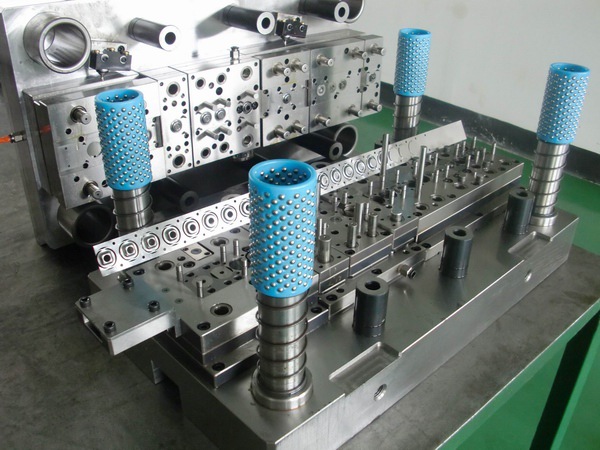
A progressive die contains several working stations inside one tool. A metal strip moves forward at a fixed pitch, with each station completing part of the required geometry. Early stations may create holes or trim material, while later stations form the part and separate it from the strip.
These operations take place at the same time on different sections of the material. With every press stroke, the strip advances and one finished component leaves the final station. The process therefore removes much of the handling required when several independent dies are used.
| Production Factor | Separate Die Process | Progressive Die Process |
|---|---|---|
| Handling | Parts move between operations | Material remains in one strip |
| Operations per cycle | Usually one | Several stations work together |
| Positioning | Repeated for each step | Controlled inside the die |
| Production speed | Limited by transfers | Driven mainly by press speed |
| Suitable volume | Low or changing demand | Stable repeat production |
The cost advantage of a progressive die does not come from making one forming action faster. It comes from simplifying the entire production route. Automatic feeding reduces manual intervention, while integrated stations remove repeated setups and transfers.
The tooling investment is also spread across the expected production quantity. As more parts are produced, the effective mold cost assigned to each component decreases.
Tooling cost per part = Total tooling investment ÷ Expected production quantity
This formula provides a useful starting point, but the final decision should reflect the complete production cost. A progressive die may offer better value when it reduces the time and waste associated with a multi-step process.
A progressive die is usually suitable when a part requires several operations and will be produced repeatedly over a stable period. The design should also be compatible with continuous strip feeding.
There is no fixed production quantity at which progressive tooling automatically becomes economical. The break-even point depends on the complexity of the part and the cost of producing it through other methods. A simple component may justify progressive tooling at a moderate volume, while a difficult forming project may require a larger forecast.
Design stability is equally important. Because several stations are built around one part geometry, major design changes can be costly after the mold has been completed. Progressive tooling is therefore better suited to mature parts than to products that are still being revised frequently.
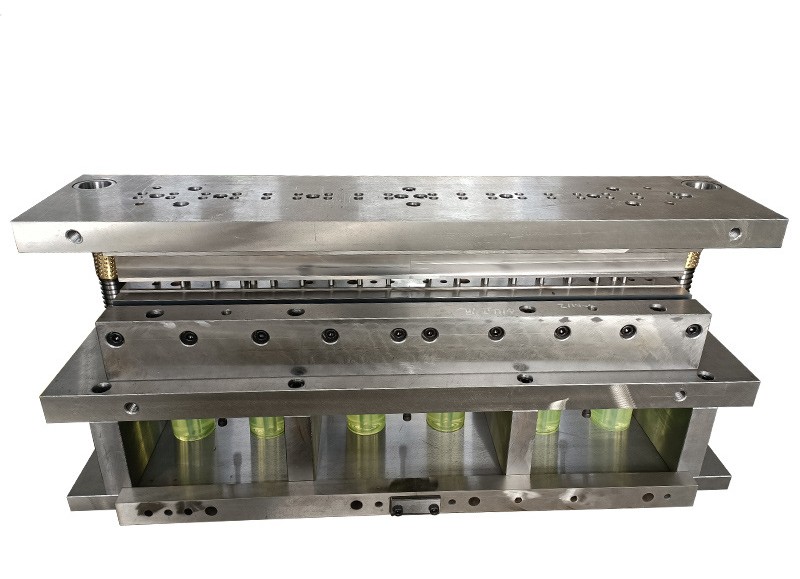
A more complex die is not always a better die. For prototypes, small orders, or designs that are still changing, a simpler stamping mold may provide greater flexibility and lower financial risk.
Part size and forming behavior may also limit the use of progressive tooling. Large components or parts that must be repositioned between stages may be better suited to a transfer process. The mold type should therefore follow the actual production requirement rather than a general preference for greater automation.
A progressive die is a coordinated forming system rather than a group of unrelated punches. The order of the stations determines how the material changes as it moves through the tool.
A feature may need to be formed gradually instead of being completed in one stroke. Likewise, a hole may need to be created before the surrounding geometry makes it difficult to access. The carrier strip must remain strong enough to guide the part until the final station.
For formed components, the designer must plan how the material will move and recover during each stage. A poor decision at an early station can create dimensional problems later in the process. This is why a DFM review should be completed before mold manufacturing begins.
The strip layout defines how the component is arranged in the raw material and how it travels between stations. A compact layout may reduce scrap, but it must still provide enough support for reliable feeding.
This balance becomes important in high-volume production. A small improvement in material utilization may create meaningful savings over a long order, but an unstable strip can lead to interruptions that outweigh those savings.
The feeder moves the strip forward after every press cycle. Pilot pins then position it accurately before the next operation takes place.
This repeated positioning keeps features created at different stations aligned with one another. If the feed is unstable, even a precisely manufactured mold may produce inconsistent parts. Reliable progressive stamping therefore depends on the die and feeding system working together.
Metal changes slightly after the forming pressure is released. The die design must account for this recovery so that the finished part reaches the required shape.
For more difficult features, forming may be divided across several stations. Gradual forming provides better control and can reduce the risk of damaging the material.
A mold used for repeat production is exposed to continuous impact and friction. Tool material must therefore provide an appropriate balance between wear resistance and toughness.
The correct choice depends on the part material and the expected production life. Heat treatment and machining quality are also important because even good tool steel can fail if it is processed incorrectly.
Wear components should be designed for practical maintenance. Replaceable punches and inserts allow damaged areas to be repaired without rebuilding the complete mold. This can reduce downtime and make the tool more economical over its service life.
Progressive dies require more design work and more complex manufacturing than simple dies. Comparing suppliers only by the mold price can therefore create a misleading impression.
| Cost Factor | Simple Tooling | Progressive Stamping Mold |
|---|---|---|
| Initial investment | Lower | Higher |
| Manual handling | Usually higher | Usually lower |
| Secondary work | More likely | Often integrated |
| Output | Lower for multi-step parts | Higher after validation |
| Low-volume economics | Often more suitable | May not recover its cost |
| High-volume economics | Recurring costs remain higher | Unit cost usually decreases |
A more useful comparison estimates the cost of producing the component over the expected program life. The objective is not to choose the cheapest tool, but to find the most stable way to produce an acceptable part at the required volume.
A supplier needs more than the finished part drawing to recommend the right stamping mold. The expected production volume helps determine whether dedicated tooling is justified, while the material and critical dimensions affect the mold structure and forming sequence.
Buyers should also explain where the mold will operate. If it will be installed in the buyer’s own factory, the tool must match the available press and feeding direction. Sample approval, expected mold life, maintenance responsibilities, and spare components should be agreed before manufacturing begins.
Discussing these points early allows the supplier to design the mold around the real production environment rather than making assumptions based only on the part geometry.
A complete quotation request should normally include:
2D drawings and available 3D models
Material grade and thickness
Annual forecast and expected program life
Critical dimensions and surface requirements
Press specifications when the mold will run in-house
Sample approval and mold-life expectations
Providing the expected production rate and assembly requirements can also help the supplier choose between a progressive, compound, transfer, or single-operation die.
YX Tech provides custom stamping mold development for prototype and production projects. Available options include single-operation, compound, progressive, and transfer dies.
The mold type is selected according to the part design and expected production demand. Before manufacturing begins, the engineering team can review the drawing and discuss forming feasibility, strip layout, and the dimensions that require the closest control.
Mold production is supported by CNC machining, EDM, wire cutting, milling, drilling, and grinding equipment. Tool steels and replaceable inserts can be selected according to the required service life.
YX Tech accepts common technical file formats, including STEP, STP, IGS, SLDPRT, PDF, and DXF. Buyers can submit their drawings together with the material, production forecast, tolerance requirements, and available press information for review.
A progressive die combines several stamping operations into one continuous process. Its higher initial price can be justified when it reduces repeated handling and supports stable production over a large quantity.
However, progressive tooling is not suitable for every project. The part design, expected volume, production equipment, and likelihood of future changes should all be considered before the mold type is selected.
The best stamping mold is not necessarily the most advanced or the least expensive. It is the tool that fits the real production program and delivers a reliable cost per part over time.
Contact YX Tech to review your part drawings, material requirements, production forecast, press specifications, and tooling strategy.
A stamping mold is a tool installed in a press to cut or form sheet metal into a specified shape. It may complete one operation or combine several steps in one production cycle.
A progressive stamping mold contains several stations that process a metal strip in sequence. The strip advances after each press stroke, and a finished part is separated at the final station.
They reduce separate handling and combine multiple operations into one continuous process. This can improve output and lower recurring costs when production volume is high.
It may not be suitable for small orders, frequently changing designs, very large parts, or components that must be repositioned during forming.
Price is mainly influenced by part complexity, die size, number of stations, required accuracy, tool material, and expected service life.
Provide drawings, material specifications, production quantity, critical tolerances, surface requirements, and press information if the mold will be used in your own facility.


 English
 日本語
日本語 Deutsch
 Español
 français
 italiano
 Polska
 العربية
 čeština
 Svenska
 Nederland